




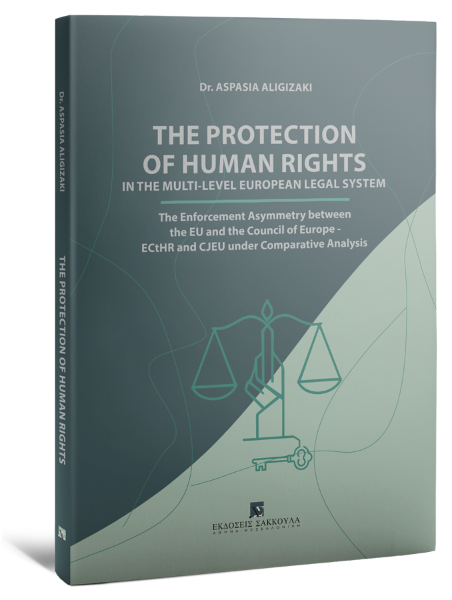


A. Aligizaki, The Protection of Human Rights in the Multi-Level European Legal System:, 2026

The present study focuses on three fields of rights that function as barometers: freedom of expression (Article 10 ECHR, Article 11 CFR), freedom of religion (Article 9 ECHR, Articles 10 and 21 CFR), and the right to liberty and security (Article 5 ECHR). Their selection is not arbitrary. The first is tested daily by digital disinformation and new forms of censorship. The second comes into conflict with demands of secularism and the rights of minority groups. The third faces challenges from administrative detention, counter-terrorism legislation, and digital surveillance.
All three are situated within a broader question that runs through the entire study – a question that, although it may appear to concern the architecture of systems, in reality touches on the everyday experience of the citizen: why do two European systems that entrench the same rights offer different protection to the same citizen?
The selection of these three rights is neither coincidental nor merely thematic. Each of them represents a different type of asymmetry, and their joint analysis allows the phenomenon to be illuminated from multiple angles, without confining it to a single dimension.
The focus on these three rights, therefore, does not exhaust the field of asymmetry, but covers it in a manner that highlights the variety of problems, namely external and internal asymmetry, asymmetry between preventive and repressive regulation, and asymmetry according to the geographical scope of application.
Πληροφορίες έκδοσης
Πίνακας περιεχομένων +
Table of Contents
Introduction
Chapter
Freedom and Right: From Etymology and Philosophical Interpretation to the Asymmetry of Their Legal EnforcemenT
1.1. Freedoms and Rights: A Conceptual Distinction That Matters
1.2.The Etymology of the Word “Ἐλευθερία”: Two Traditions, Two Legal Consequences
1.3. The Stoic Conception of Inner Freedom and Its Legal Implications.
1.4. Free Will, Responsibility, and Their Legal Foundations
1.5.From Natural Law to Legal Entrenchment: Inner Freedom as an Institutional Demand
1.6. The Ancient Greek Heritage in Modern Law
1.7.From Philosophy to Enforcement: Why Foundation Alone Does Not Suffice
1.8. Freedom as a Legal Concept: A Multidimensional Synthesis
1.9. From Theory to Practice: What All This Means
Chapter
National Law as Foundation: Constitution, Legal Order, and Dual Subjection
2.1. Introduction: Why National Law Remains the Foundation
2.2. The Greek Constitution of 1975: Historical Context and Structural Logic
2.3. Article 28 of the Constitution: The “Open Clause” and Dual Subjection
2.4.The Qualitative Requirement of “Prescribed by Law”: When Formal Validity Is Not Enough
2.5. Custom and Generally Recognised Rules: The Oldest Source
2.6. The Greek Experience: When the National System Fails
2.7. Conclusion: National Law as Starting Point, Not as Endpoint
Chapter
International Human Rights Law: Sources, Mechanisms, and the Problem of Enforcement
3.1. Introduction: The Paradox of “Richness” without Enforcement
3.2. The United Nations Charter: The Foundations without the Building
3.3. The Universal Declaration of Human Rights: Moral Authority, Legal Weakness
3.4. The Two International Covenants of 1966: From Declaration to Binding Force
3.5. Specialised UN Conventions: Normative Richness and Enforcement Weakness
3.6. The European Convention on Human Rights: The Regional Step
3.7. Conclusion: The Paradox of Authority without Enforcement
Chapter
EU Law: A System With Coercive Force
4.1. EU Law: A Different Logic of Enforcement
4.2. The Three Principles That Make the Difference: Van Gend en Loos, Costa, and Francovich
4.3. The Charter of Fundamental Rights: From Political Declaration to Binding Rule
4.4. The Enforcement Tools: From Theory to Practice
4.5. The EU-ECHR Relationship: The Bosphorus Presumption and the Failure of Accession
4.6. Monism, Dualism, and the Reality of the Greek Legal Order
4.7. The Promise and Its Limits: Why Even the Stronger System Leaves Gaps
4.8. Conclusion: EU Law as Both Manifestation and Limit of the Asymmetry.
Chapter
The ECHR and the ECtHR: Jurisprudential Completeness and Weakness of Execution
5.1. Introduction: The ECHR System as the “Other End” of the Asymmetry
5.2. The ECHR as a Normative Text: Rights, Protocols, and Scope of Application
5.3. The ECtHR as a Court: Structure, Formations, and the Problem of Access
5.4. The Individual Application: Filters, Time Limits, and the Logic of Subsidiarity
5.5. The Execution of Judgments: Where the Real Problem Begins
5.6. The Greek Experience: Where the Weakness Becomes Visible
5.7. Conclusion: Jurisprudential Completeness and Enforcement Weakness
Chapter
European Protection Mechanisms: The Enforcement Asymmetry Between the ECHR and EU LAW
6.1. Introduction: Two Systems, One Europe – The Problem of Coexistence.
6.2. The ECtHR: Jurisprudential Excellence with a Cracked Foundation
6.3. Structure and Functioning: A Court That Filters Access
6.4. Admissibility Requirements: The Filters That Restrict Access to Justice.
6.5. Fundamental Principles of the Case Law: The Strength of the Interpretive Model
The “Living Instrument” Principle
The Margin of Appreciation
The Principle of Proportionality
6.6. Selected Case Law: Judgments That Shaped European Law
6.7. Execution of Judgments: Where the Real Problem Begins
6.8. Greece before the ECtHR: A Relationship of Maturation with Recurring Patterns
6.9. The Comparative Analysis: Why Jurisprudential Excellence Is Not Enough
Access to Justice
Execution of Judgments
Positive Obligations
The Paradox of Inversion
6.10. Conclusion: From Case Law to Enforcement – The Unresolved Question
Chapter
The Greek Experience With the Charter: From Theory to Practice
7.1. Introduction: Why the Greek Experience with the Charter Differs from the Experience with the ECHR
7.2. The Incorporation of the Charter into the Greek Legal Order: From the Treaty of Lisbon to the Council of State’s Case Law
7.3. The Charter–ECHR Relationship in Greek Case Law: When the Two Systems Meet in Greek Courts
7.4. Cases Where the Charter Offered Stronger Protection than the ECHR in Greek Practice
7.5. Cases Where the ECHR Offered Protection that the Charter Could Not (Outside the EU Field)
7.6. The Greek Data Protection Authority as an Enforcement Mechanism: Comparison with the Committee of Ministers
7.7. Conclusion: The Greek Experience as a Microcosm of the Enforcement Deficit
Chapter
The Protection of the Rule of Law: When the Same Problem is Addressed by Two Systems With Different Outcomes
8.1. Introduction: The Rule of Law as a Testing Ground
8.2. The Same Phenomenon, Two Systems: The Case of Poland
8.3. The Hungarian Case: When the Prosecution Service Becomes a Political Instrument
8.4. Article 7 TEU: The Limit of Political Enforcement
8.5. The Conditionality Regulation: Economic Pressure as a Lever – and Its Limits
8.6. The European Arrest Warrant: When the Dismantling of the Rule of Law Has Concrete Consequences
8.7. Conclusion: Functional Necessity as an Interpretive Key
Chapter
Freedom of Expression: The Enforcement Asymmetry Between the ECtHR and the CJEU as a Test of The Multi-Level System
9.1. Introduction: Why Freedom of Expression Reveals the Asymmetry
9.2. Multi-Level Entrenchment: One Right, Many Sources, Unequal Mechanisms
9.3. The ECtHR’s Case Law: Sophisticated but Structurally Constrained.
9.4. The Digital Environment: When the “New Censor” Is Not the State.
9.5. The DSA: Regulating What the ECtHR Cannot Reach
9.6. The European Media Freedom Act (EMFA): When the EU Legislates for the Press
9.7. The Anti-SLAPP Directive: When a Lawsuit Becomes a Silencing Weapon and EU Law Responds
9.8. The Right to Be Forgotten: A New Concept Born in EU Law
9.9. Public Figures and Defamation: The Asymmetry in Practice
9.10. Whistleblowers: From ECtHR Case Law to EU Legislation
9.11. Disinformation: The Problem Neither System Has Fully Solved
9.12. Hate Speech, Holocaust Denial, and Article 17: The Limit That Both Systems Recognise, but in Different Ways
9.13. The Greek Case: A Revealing Case Study on the Relationship between the Enforcement Deficit and National Security
9.14. Conclusion: Freedom of Expression as a Barometer of the Asymmetry – and the New Challenges That Widen the Gap Further
Chapter
Freedom of Religion: Article 9 ECHR and Anti-discrimination Law
10.1. Introduction: Freedom of Religion as a Field of Double Asymmetry
10.2. Philosophical and Historical Foundations: Why Conscience Does Not Submit to Coercion
10.3. International and European Entrenchment: The Absolute Protection of the Forum Internum and the Limits of the Forum Externum
10.4. Forum Internum – The Absolutely Inviolable Sphere and Its Limits in Practice
10.5. Forum Externum – The External Manifestation and the Wide Margin of Appreciation
10.6. Religious Symbols in the Public Sphere: The ECtHR’s Case Law and Cultural Heterogeneity
10.6(a). Leyla Şahin v. Turkey – The Headscarf at University
10.6(b). Lautsi and Others v. Italy – The Crucifix in Schools
10.7. Religious Symbols in the Workplace: Where EU Law Enters the Picture.
10.8. EU Law and Freedom of Religion in Employment: Strong but Narrow Protection
10.9. Laïcité, Secularism, and Freedom of Religion: The Wide Margin as an Indicator of Weakness
10.10. Freedom of Religion and Conscientious Objection: Where the ECtHR Changed Its Approach
10.11. The Conflict between Freedom of Religion and Other Rights: Where the ECtHR Struggles to Enforce a Balance
10.12. Freedom of Religion in Greek Law: Where the Asymmetry Becomes Visible
10.13. Freedom of Religion in the Digital Age: New Challenges, Old Gaps
10.14. Conclusion: Freedom of Religion as a Barometer of Double Asymmetry
Chapter
The Right to Liberty and Security: Article 5 ECHR and the EU’S Area of Freedom, Security and Justice
11.1. Introduction: Liberty as a “Hard” Right and the Particularity of the Asymmetry
11.2. Philosophical and Historical Foundations: From Habeas Corpus to the Contemporary Asymmetry
11.3. International and European Entrenchment: The Minimum Standard and the European Advance
11.4. The Concept of Deprivation of Liberty: Where the ECtHR Delineates Protection
11.5. The ECtHR’s Fourfold Review: A Mature but Reactive Structure
11.6. Procedural Rights: Notification, Production before a Judge, and Habeas Corpus
11.7. The Review of Lawfulness and Its Effectiveness: Where the ECtHR Reveals the Enforcement Deficit
11.8. The Area of Freedom, Security and Justice: The EU’s Response at the Cross-Border Level
11.9. The European Arrest Warrant: Strong Enforcement with Limits
11.10. The ECtHR’s Case Law on Greece: Where the Asymmetry Becomes Visible
11.11. Conclusion: Liberty as a Field of “Reverse” Asymmetry
Chapter
The Enforcement Deficit: A Comparative Analysis of the Enforcement Mechanisms of the ECtHR and the CJEU
12.1. The Question Left Unanswered: What Happens After the Judgment?
12.2. The Three Levels – Three Dimensions of Protection: A Comparative Assessment
12.3. The Question Hidden Behind Every Right: The Empirical Evidence of the Asymmetry
12.4. The Asymmetry as a Structural Feature: Why It Is Not Temporary
12.5. The Greek Case: Where the Asymmetry Becomes Visible in Everyday Life
12.6. Prospects for Strengthening: What Can Be Done?
12.7. Conclusion: The Asymmetry as a Challenge and as an Opportunity
Chapter
Greece as a Microcosm of the Enforcement Deficit in Human Rights Protection: An Empirical Analysis of Two Systems
13.1. Introduction: Why Greece Is a Revealing Example
13.2. Structural Patterns of Violation: Greece before the ECtHR
13.3. Georgiou v. Greece: When the Two Systems Meet on Greek Soil
13.4. When the Two Systems Confront the Same Problem: M.S.S. and N.S
13.5. The Koukakis Case and Predator: The Most Contemporary Expression of the Enforcement Deficit
13.6. Conclusion: What the Greek Experience Teaches Us
Chapter
Conclusions
14.1. Answer to the Research Question: The Enforcement Asymmetry as a Structural Feature
14.2. The Greek Case as a Case Study
14.3. The Three Levels of Asymmetry: National, International, and EU
14.4. The Open Fronts: The Digital Age, the Rule of Law, and EU-ECHR Accession
14.5. Proposals de lege ferenda
14.6. Methodological Conclusions
14.7. Epilogue
Bibliography
A. Greek Bibliography
B. Foreign-Language Bibliography
C. Case Law – European Court of Human Rights (ECtHR)
D. Case Law – Court of Justice of the European Union (CJEU)
E. Case Law – National Courts
F. Case Law – International Courts and Committees
G. Legislation
G.1. International Instruments
G.2. European Convention on Human Rights and Council of Europe
G.3. European Union Law
G.4. Greek Legislation
H. Other Sources
Τύπος περιεχομένου
Κατηγορίες
Σχετικές εκδόσεις


